Adhere to the employment priority strategy: consolidate the foundation of people’s livelihood and improve people’s well-being
【Endeavor, New Journey, New Era and Extraordinary Decade】
[Ten-year answer sheet]
Guangming Daily reporter Qiu Yue
Employment is the biggest livelihood, which is related to the lives of thousands of families. China has a population of more than 1.4 billion and a labor force of 900 million. Solving the employment problem is always a major task for economic and social development.
Since the 18th National Congress of the Communist Party of China, the CPC Central Committee with the Supreme Leader as the core has attached great importance to employment, clearly put employment at the top of the "six stabilities" and "six guarantees", strengthened the employment priority policy, and promoted the employment work to achieve historic achievements in the past ten years. In the past ten years, the employment situation has remained generally stable, and relatively full employment has been achieved in a big country with a population of more than 1.4 billion, and higher-quality employment has become a reality step by step.
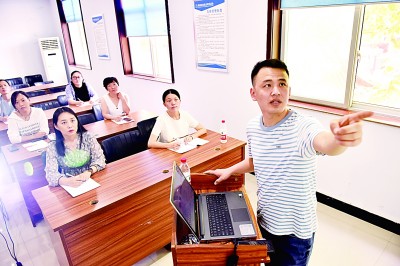
At the e-commerce incubation base in Nanhan Village, Nanhe District, Xingtai City, Hebei Province, returning entrepreneurial college students are training employees in network business. Xinhua news agency
1. Historical changes have taken place in the urban and rural employment pattern.
Since the 18th National Congress of the Communist Party of China, in accordance with the decision-making arrangements of the CPC Central Committee, all regions and departments have closely focused on achieving more adequate and higher-quality employment goals, implemented the employment priority strategy in depth, enriched and developed active employment policies, and continuously strengthened the employment priority orientation. Under the circumstances of China’s economic downturn and complicated and severe external environment, the employment situation has remained generally stable, achieving relatively full employment in a big country with a population of more than 1.4 billion, which has become an important support for improving people’s livelihood and economic development.
In the past ten years, the number of new jobs in cities and towns in China has exceeded 13 million annually, and 130 million new jobs have been created in cities and towns in the past ten years. The data shows that in 2014, the proportion of employed people in urban areas exceeded that in rural areas for the first time, and the employment pattern in urban and rural areas in China has undergone historic changes. In 2021, the proportion of employed people in urban areas reached 62.7%, an increase of 13.8 percentage points over 2012. At the same time, the labor force in the central and western regions has an obvious trend of local employment and returning to their hometowns to start businesses. Many cities and counties have changed from labor exporting places to labor importing places. "Employment no longer goes far away, and hometown is a good place" has become a new trend for migrant workers, and the regional employment structure has become more balanced.
In the past ten years, the employment of key groups such as college graduates, migrant workers and people with employment difficulties has been stable. The key groups are stable and the overall employment situation is stable. With the number of college graduates increasing year after year, the overall employment level of more than 80 million college graduates has remained stable. The total number of migrant workers increased from 262.61 million in 2012 to 292.51 million in 2021. A total of 55.01 million unemployed people were promoted to re-employment, and 17.68 million people with difficulties were helped to find jobs.
It is worth noting that since the 18th National Congress of the Communist Party of China, employment has played a great role in helping the poor. During the implementation of the poverty alleviation strategy, more than 90% of the poverty-stricken people who set up a file and set up a card were supported by industrial poverty alleviation and employment poverty alleviation, and more than two-thirds of them mainly relied on migrant workers and industries to get rid of poverty. China has built a total of 32,688 poverty alleviation workshops, attracting 437,000 poor people to work at their doorsteps, and nearly 30 million poor laborers are working outside the country.
Behind every job is the happiness of a family. Since the 18th National Congress of the Communist Party of China, employment has played an active role in promoting the stable and coordinated development of the economy and society. Both the registered unemployment rate in cities and towns and the surveyed unemployment rate in cities and towns have remained at a low level. Even in the face of the impact of various internal and external factors, such as the downward pressure on the economy, the trade friction between China and the United States and the COVID-19 epidemic, China’s labor market still shows strong resilience.

The Miao nationality "Xiuniang" in Kaili, Guizhou Province, with the support of government skills training and financial support, started the road to entrepreneurship. Xinhua news agency
2. The "inverted pyramid" employment structure has gradually taken shape.
Employment is the "barometer" of the economy, and the high-quality development of the economy has brought higher-quality employment. Since the 18th National Congress of the Communist Party of China, under the guidance of the new development concept, China has accelerated the promotion of high-quality economic development, the transformation of manufacturing industry, the upgrading of service industry, the growth of private economy and small and micro enterprises, mass entrepreneurship and innovation, and emerging employment forms and new employment opportunities, which have effectively promoted the optimization of employment structure and quality improvement.
With the accelerated transformation and upgrading of China’s industrial structure, the ability of the tertiary industry to absorb employment continues to increase, and the proportion of employees has increased from 36.1% in 2012 to 48% in 2021, making it the largest "container" for employment. The proportion of employees in the primary, secondary and tertiary industries has been adjusted from 33.5%, 30.4% and 36.1% in 2012 to 22.9%, 29.1% and 48% in 2021, and an "inverted pyramid" employment structure has gradually taken shape. With the rapid rise of new formats such as digital economy, take-away delivery, online car rental, webcast, e-commerce, and accompanying diagnosis … … These new and flexible forms of employment are more and more deeply integrated into people’s daily life.
From the social point of view, high-quality employment means the improvement of production efficiency. In the past ten years, the labor productivity of the whole society has increased from 81,000 yuan to 146,000 yuan, and more workers have moved from low-productivity departments to high-productivity departments. At present, the total number of skilled workers in China has increased to more than 200 million, of which more than 60 million are highly skilled, and the skills and quality of workers have improved significantly. In the past ten years, the income of Chinese workers has continued to increase. In 2021, the wages of employees in urban units doubled compared with that in 2012. At the same time, the coverage of social insurance continued to expand, and the protection of the rights and interests of flexible employees continued to improve.
On the eve of China’s entering a new stage of development, the Fifth Plenary Session of the 19th CPC Central Committee listed "achieving more full and higher quality employment" as the main goal of economic and social development during the 14th Five-Year Plan period, which indicated that after China achieved a well-off society in an all-round way, it put forward higher requirements for employment work facing the new goal of common prosperity.
3. The employment policy support system is becoming increasingly sound.
The General Secretary of the Supreme Leader pointed out: "We must adhere to the employment priority strategy, put solving the employment problem of the people in a more prominent position, and strive to create more jobs." Since the 18th National Congress of the Communist Party of China, in view of the new situation, new tasks and new requirements faced by China’s employment, China’s employment work has also experienced great changes from "active employment policy" to "more active employment policy" and then to "employment priority strategy". The party and the government regard stabilizing and expanding employment as an important goal of economic and social development, push employment priority from the strategic level to the macro-policy level, and put stabilizing employment and ensuring employment at the top of the "six stabilities" and "six guarantees".
"Innovatively implement the employment priority policy and put it at the macro level, and the policy tools for reducing burdens, stabilizing posts and expanding employment are rich and perfect." Jong Li, Vice Minister of Ministry of Human Resources and Social Security, said that China’s employment priority strategy has been thoroughly implemented, the active employment policy has been continuously enriched and developed, and the employment priority orientation has been significantly enhanced. In the past ten years, the top-level design of the employment priority strategy has been gradually strengthened, the government’s policy content of stabilizing employment has been enriched, the policy tools have been enriched, and the coordination of various departments in implementing employment policies has been further improved.
Faced with the impact of the epidemic and the downward pressure of the economy, China has successively launched the policy of "lowering, slowing down, returning and supplementing", continued to implement the phased fee reduction policy for unemployment and work-related injury insurance, allowed the extremely poor industries to postpone the payment of three social insurance premiums in stages, improved the standard for the return of unemployment insurance for small and medium-sized enterprises, strengthened the implementation of social security subsidies, training subsidies and other policies, and introduced one-off training subsidies to help enterprises stabilize their posts and expand their posts. In 2021, in order to support market players to stabilize jobs, the central government thoroughly implemented policies to reduce burdens, stabilize posts and expand employment, adjusted and optimized policies and measures such as returning stable posts and employment subsidies, and spent nearly 100 billion yuan on employment subsidies throughout the year; Unemployment insurance was distributed to 4.07 million enterprises, and 23.1 billion yuan was returned to their posts, benefiting 92.34 million employees.
4. The legitimate rights and interests of workers have been effectively safeguarded.
In late July, Zhao Qi, a 2022-year-old graduate of Beijing Jingbei Vocational and Technical College, found a favorite job for her major by participating in a special recruitment activity for nursing majors organized by the Human Resources and Social Security Bureau of Miyun District, Beijing. "For job seekers, live broadcast with posts can provide relatively accurate job information, saving a lot of time and energy."
While jobs are presented to the society, what grows with them is the increasingly perfect employment service system. In the past ten years, the construction of all-round public employment service system has been continuously promoted, and the five-level public employment service network covering provinces, cities, counties, streets (towns) and communities (villages) has been gradually improved, and the standardization, intelligence and specialization have been further strengthened. The special activities such as the Spring Breeze Action and the 100-day Online Recruitment Special Action have achieved remarkable results. Public employment and talent service institutions at all levels provide recruitment services for 80 million workers and 50 million employers every year. The scale of human resources service industry is growing day by day. By the end of 2021, there were 59,100 human resources service institutions in China, effectively increasing the supply of employment services.
At present, China has initially established a lifelong vocational skills training system. By improving the lifelong vocational skills training system, we will solidly promote the teaching reform of work-integrated learning, improve the training, use, evaluation and incentive mechanism of skilled personnel, strengthen the construction of high-skilled personnel, and extensively carry out vocational skills competitions. We will implement the three-year action of upgrading vocational skills from 2019 to 2021, allocate 100 billion yuan from the balance of unemployment insurance fund, and carry out subsidized vocational skills training for more than 83 million people in various forms, so that our ability to stabilize employment and change jobs has been continuously enhanced.
At the same time, the rights and interests of Chinese workers have been effectively safeguarded, and the institutional mechanism for building a harmonious labor relationship with China characteristics has basically taken shape. In the past ten years, China has successively issued regulations to protect the wage payment of migrant workers, revised the labor contract law, standardized labor dispatch, and issued special provisions on labor protection for female employees, thus further improving the legal system of labor relations.