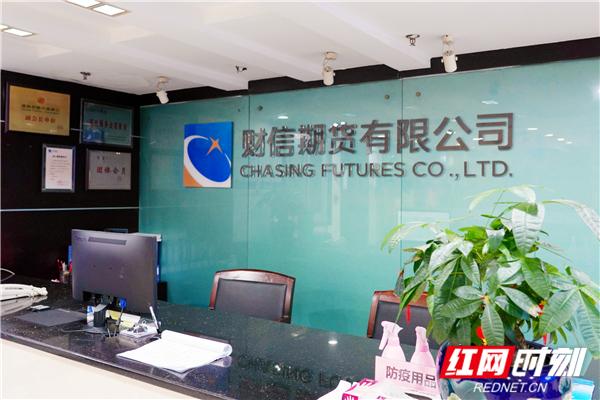
Editor’s note:Recently, the General Office of the State Council issued the Notice on Further Strengthening Assistance to Small and Medium-sized Enterprises, clearly proposing to promote futures companies to provide risk management services for small and medium-sized enterprises. The heavy publication means that the role of futures in serving the real economy is increasingly prominent. In what ways can futures risk subsidiaries serve entities? How will it be implemented? What practical problems can be solved for enterprises? From now on, Caixin Futures, a subsidiary of Hunan Caixin Financial Control Group, will launch a series of articles to give the answer.
For a long time, the standardized products and tools in the futures market can hardly meet the individual needs of enterprises, and it is difficult for the futures industry to solve the "last mile" problem of serving the real economy. The risk management company makes the futures market and the spot market well interconnected and common, and truly puts the futures market to serve the real economy. In the development process in recent years, the related businesses of risk management companies serving the real economy have gradually become refined and diversified. Going deep into the industrial chain, cooperating with industrial customers and providing personalized services, risk management subsidiaries are getting wider and wider on the road of serving entity enterprises.
OTC derivatives business is a unique business model given to risk management subsidiaries by China Futures Association. Since 2018, the development of OTC derivatives business has been gradually sublimated, the awareness of entities on OTC derivatives has been continuously improved, and personalized needs have been met to varying degrees through OTC derivatives business. The tools of OTC derivatives are constantly updated, and OTC swaps and OTC options, especially the introduction of "insurance+futures", have been affirmed for many years in a row.
OTC option is mainly an OTC derivative tool for risk managers to avoid the risk of price fluctuation by making use of their own professional advantages and tailored to the needs of entities. For example, an entity enterprise will sell a batch of goods in the future, and the current price has a good profit margin for the enterprise, but the future price is uncertain. If the futures market is hedged, the enterprise will lose the profit brought by the rising price, and if the risk management subsidiary designs an OTC put option, the enterprise can give up the exercise and continue to enjoy the profit brought by the rising price; When the price falls, the enterprise can choose to exercise the right to gain the falling income and make up for the loss of the spot sales price, which can not only lock in the risk for the enterprise, but also continue to make profits when the price continues to rise. Similarly, in the procurement of raw materials, enterprises can also effectively lock in the uncertainty risk of raw material price fluctuation through OTC options. For example, enterprises are worried about rising raw material prices in the production process, and through hedging in the futures market, enterprises will lose the opportunity of further reducing costs due to falling prices. Buying a call option through a risk management subsidiary can not only lock in the cost of raw materials for enterprises, but also choose to give up the exercise and purchase raw materials at a lower price when prices continue to fall.
Over-the-counter swap refers to the transaction form in which the two parties agree to exchange certain assets with each other in a certain period in the future. In bilateral transactions between customers and dealers, the price or index of a commodity is generally the target, and it is agreed that at a certain point in the future, one of them will pay a fixed price and the other will pay a floating price based on prior agreement. After the expiration, both parties only need to complete the cash transfer of the difference between the two prices. For example, an enterprise has a large inventory of commodities, and on the one hand, it lacks professionals, on the other hand, it lacks corresponding funds. At this time, the enterprise signs a swap agreement through a risk management subsidiary, pays a certain guarantee, and sells the commodity price or commodity index. This can lock in the sales price of the stocked commodities and avoid the risk of price fluctuation. Compared with futures hedging, it solves the enterprise’s concerns about contract expiration, professional personnel allocation and lack of funds.
"Insurance+futures" mainly means that when farmers sell goods, they can protect the prices of the goods they sell at the lowest price, which eliminates farmers’ worries about the continuous decline of commodity prices. With "insurance+futures", farmers can lock in the sales prices of future goods within the foreseeable cost range. In recent years, the risk management subsidiary has promoted insurance+futures in many commodities, including cotton, sugar, rubber, pigs, apples, soybeans, corn, eggs, etc., and achieved remarkable results, which effectively solved farmers’ concerns about the decline in commodity prices when they went public. Hunan is a famous province for pig breeding in China. Through insurance+futures, Caixin Risk Management Subsidiary can give full play to its professional advantages, provide professional insurance+futures services for farmers in Hunan, and escort the pig prices of farmers.
Generally speaking, OTC derivatives business is the foothold for risk management subsidiaries to provide personalized and professional services for entities, which can do a good job in price risk management for entities, solve the concerns of enterprises about the uncertainty of price fluctuations, and let entities have more energy to focus on their main business operations.
Caixin Futures Risk Management Subsidiary Services Entity Enterprise-Basis Trade
The risk management subsidiary of Caixin Futures serves the entity enterprise-warehouse receipt service.
Reporting/feedback

关于作者