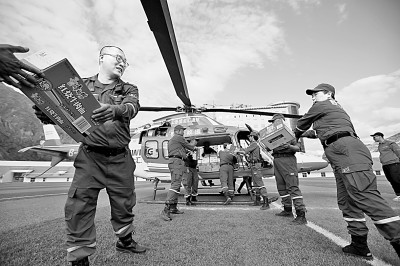
In August, 2020, a flood and debris flow disaster occurred in Longnan City, Gansu Province. The members of the Blue Sky Rescue Team and local staff carried the urgently needed materials to the rescue helicopter. Photo by Ran Chuangchang/Bright Picture
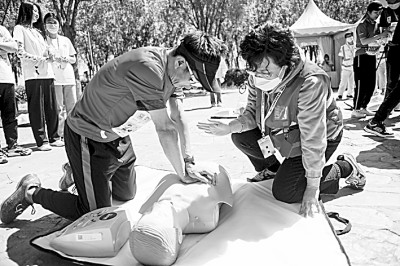
On May 8, 2021, the "Le Ballon Rouge" orienteering race and the Beijing-Tianjin-Hebei emergency rescue talent competition were held in the Green Heart Park of Tongzhou City, Beijing. The picture shows the contestants performing CPR first aid operation. Xinhua news agency
【 View of Law Eyes 】
November 7 is a Sunday, and Ren Keyi has been busy until nearly 10 pm. As the captain of the Blue Sky Rescue Team in Jishan County, Yuncheng City, Shanxi Province, he took the team members to visit 19 families in Jingping Village and distributed winter clothes and stationery to the children. Unlike the unified relief materials, these clothes were chosen by the children themselves.
From the night of October 2 to 6, extremely heavy precipitation occurred in most parts of Shanxi, and the flood disaster caused concern. The rain in Jishan County began in late August. This county is adjacent to the Fenhe River, and the rainfall is sometimes small, which eventually led to the Fenhe dam being washed away by the flood. After the hot search for emergency rescue and disaster relief, the post-disaster reconstruction work continues.
This batch of winter clothes was supported by fundraising from partner organizations, and Han Qing team from Zhengzhou, Henan Province coordinated local partners to distribute them together. Han Qing’s team has organized material donations in many major disasters, and is quite experienced in this respect. However, he has not registered as a public welfare organization, but has been affiliated with other registered institutions as one of the projects every time. "Mainly to maintain flexibility, if I am officially registered in a certain district of Zhengzhou, in principle, I can only provide services there, but disaster relief itself is a cross-regional work." He said.
These "troubles" are waiting to be pushed forward. The National People’s Congress Standing Committee (NPCSC) charity law enforcement inspection report also elaborated the challenges faced by charity law in rescuing natural disasters and other emergencies, and called for revision to solve the outstanding problems.
1. Policy support needs further implementation.
Blue Sky Rescue Team is an eye-catching figure in many disaster relief sites. There are nearly 800 rescue teams with brand authorization all over the country, which are well-known, but recently they have also faced some embarrassment similar to Han Qing.
On October 14th, official website, the Beijing Civil Affairs Bureau, issued a public notice of administrative punishment, and the Beijing team, the founding team of Blue Sky Rescue Team, was given a warning, ordered to stop its activities for six months and fined 20,000 yuan. The reason is that it has set up branches in violation of regulations, which violates the provisions of Article 13 of the Provisional Regulations on the Registration and Administration of Private Non-enterprise Units. At the same time, there are behaviors that do not have the qualification to conduct public fundraising, which violates the provisions of Article 26 of the Charity Law.
Zhang Yong, the commander-in-chief of Beijing Blue Sky Rescue Team, explained in an interview with the media that the administrative punishment of the Civil Affairs Bureau determined that Beijing Blue Sky Rescue Team had set up seven regional rescue teams and a pickup truck mobile team, which was an act of illegally setting up branches. "Beijing is so big that we have to have various groups to carry out services. For many years, it has been customary to call it administrative divisions. For example, the action group in Fengtai is called Fengtai Blue Sky Rescue Team, and I have never considered this issue before." In principle, these action groups should be registered separately in Fengtai and other districts.
2008 was called "the first year of voluntary service in China", and charitable organizations showed a blowout development after the Wenchuan earthquake. Based on the implementation experience of the Regulations on the Management of Foundations, the Regulations on the Registration of Social Organizations, the Provisional Regulations on the Registration of Private Non-enterprise Units and the Donation Law for Public Welfare, the Charity Law was promulgated in 2016.
"The charity law has been brewing for nearly 10 years, with a tortuous course and constant controversy. A core dispute is whether to adopt supervision and regulation or encourage development. " Xu Jialiang, Dean of China Institute of Public Welfare Development of Shanghai Jiaotong University, participated in the drafting of the expert opinion draft of the draft charity law. He recalled, "There are still two big disputes. One is whether charity belongs to the society or the government. If the government wants to do it, how much should it be done? Second, charity is done by professional institutions, or by each subject. " In the end, it was basically agreed that in order to supervise on the basis of promotion and encouragement, the government still reserved a part of charitable affairs, most of which were done by the society, and it was also clear that charitable organizations should do it as professional institutions and professionals, without excluding the participation of other subjects.
After the legal revision was initiated in the National People’s Congress Standing Committee (NPCSC) this year, several expert seminars showed that the effectiveness of charity law needs to be further stimulated. "Public participation has not been completely released, the overall donation scale in China has not been significantly improved, which is disproportionate to the growth of GDP, and charitable organizations have determined that their enthusiasm is not high." Xu Jialiang said.
He felt that some provisions needed to keep pace with the times. "For example, the charity law stipulated that the annual management expenses should not exceed 10% of the total expenditure of the year. For a large number of small organizations, the annual funding may be less than 1 million yuan, so the cost of employees is only 100,000 yuan, and even a full-time employee can’t be hired. "
In addition, a series of incentives and preferential policies that have been introduced need to be further implemented. For example, Huang Shuming, assistant dean of China Public Welfare Research Institute of Beijing Normal University and director of charity research center, said that one of the goals of charity law legislation is to break the dual management system and promote the direct registration of charitable organizations in the civil affairs department, that is, there is no need for a competent business department. However, in practice, the registration and establishment of the three basic forms of charitable organizations, namely foundations, social organizations and social service institutions, still need to rely on the Regulations on the Administration of Foundations, the Regulations on the Administration of the Registration of Social Organizations and the Provisional Regulations on the Administration of the Registration of Private Non-enterprise Units, and still need the competent business departments.
Among these three regulations, the Regulations on the Management of Foundations, which was formulated relatively late, has been implemented for 17 years, and many regulations can’t meet the current needs. However, the three regulations have not been revised since the introduction of the charity law, so new regulations on the management of social organizations and other supporting documents are needed to implement the institutional guarantee that charitable organizations should receive.
2. Improve the emergency coordination mechanism.
Every time there is a major disaster, social forces will be greatly activated, and public welfare undertakings bear social expectations and become more and more important.
"The charity law pays more attention to charitable acts under normal conditions, but there are only principled provisions for emergency situations. How to establish a coordination mechanism for government departments and how to mobilize social forces to participate is still lacking in specific norms at the implementation level." Huang Shuming believes that in order to do well in an emergency, we must form an institutional arrangement in which social forces participate in the normal state.
This kind of joint force is often easily lacking in disaster relief: the emergency coordination mechanism between government departments and charitable forces is insufficient, and the communication between social organizations is insufficient, thus forming an information barrier that affects the rescue efficiency. "For example, when raising money for a province, we spent a lot of time at first to verify the help-seeking information circulating on the Internet. Some help-seekers may receive verification calls from many different organizations one day." Han Qing said that first of all, it is necessary to find out what materials a place needs, and it is necessary to constantly update it. The materials needed at different stages are different. If rescuers and materials get together in some places, and no one arrives in some places for a long time, it will cause huge waste of materials and manpower.
All parties call for social forces to be included in various emergency plans. During the disaster relief process, the Jishan Blue Sky Rescue Team formed a response reporting and receiving task mechanism with the local emergency department. But in other disaster relief sites, this is not the norm.
Social forces should also have more room to play. "If donated materials are only received and distributed by the Red Cross or the Charity Federation, it is easy to manage and master information, but the transparency is not high enough and the distribution efficiency is relatively low." Many frontline workers who participated in the rescue and disaster relief said that the grassroots will face some practical problems when assigning tasks. For example, the materials received by a village are not enough to cover the whole village, and it is not appropriate for anyone to send them first, and sometimes they will not be distributed for the time being.
Collaboration has also attracted the attention of the industry. According to Peng Yanni, Secretary-General of Nandu Foundation, after the Ya ‘an earthquake in 2013, China Foundation for Poverty Alleviation and Nandu Foundation jointly launched the platform of "Foundation Disaster Relief Coordination Meeting" to promote the integration and complementarity of government disaster relief plans and foundation disaster relief actions, and promote the exchange of information between foundations. When the epidemic situation in COVID-19 is serious in 2020, relying on this platform, some social organizations that have long been concerned about the emergency field also joined in, forming a larger collaboration network.
3. Strengthen the construction of support mechanism for charitable organizations.
In 2018, China’s emergency management system was restructured. After integrating the responsibilities of various departments and institutions, the National Emergency Management Department was established, and the emergency management system and capacity strode towards modernization. The auxiliary positioning of social emergency rescue forces is more clear, but at present, the number of professional rescue organizations, especially those with disaster relief and rescue capabilities, is insufficient. They need to be included in the complete rescue system, get professional training and find a stable source of funds.
Emergency rescue is a field that relies heavily on professional ability, which requires a lot of skill training every day. Ren Xiaolun is the captain of the Blue Sky Rescue Team in Jinshui District, Zhengzhou, Henan Province, and has participated in flood rescue in Henan and Shanxi. He introduced that some team members should be able to operate lifeboats, and some should use sonar systems for underwater detection. At the same time, the whole team should undergo physical examination and have the qualification of first aid workers and radio licenses. In addition to mastering professional skills, you should also serve for a long time. At present, some social rescue forces in China are not effectively trained, and there are situations in which the rescue team itself needs rescue at the disaster relief site.
In order to improve the professionalism of the team, taking the Blue Sky Rescue Team in Jishan County as an example, the local emergency department and the Blue Sky Rescue Team organized some training, but the expenses needed to be taken care of by themselves, so the funding problem became the biggest reason for the loss of team members.
Ren Xiaolun said frankly that their lifeboats were bought by the players themselves. Usually, the accommodation and travel expenses involved in the rescue are also self-care. However, the Blue Sky Rescue Team in Jishan County has no lifeboats and other equipment, so it can only ask the rescue teams in neighboring counties for help when necessary.
Peng Yanni pointed out that there are very few funded foundations at present, and other types of social organizations often have to raise funds from other channels. In addition to self-financing, part of the funds also come from services purchased by the government and donations from enterprises or individuals.
At present, in Chengdu, Sichuan Province, where disasters are frequent, the local earthquake prevention and disaster reduction bureau provides Sichuan Blue Sky Rescue Team with expenses that can cover personnel insurance, training funds and administrative costs, but this practice is not universal. The National People’s Congress Standing Committee (NPCSC) charity law enforcement inspection report also pointed out that the government’s mechanism of supporting charitable organizations through purchasing services needs to be further improved.
Peng Yanni and Huang Zhongming both mentioned social consciousness. When a disaster occurs, a large number of donations will be received, but these are all special funds for disaster relief. Huang Shuming felt that the rescue force could not appear naturally when a disaster occurred. In the early stage, prevention and emergency preparedness, monitoring and early warning, and post-disaster reconstruction, there was not so much attention and insufficient input. In an emergency situation, everyone thinks that platform construction and team building are needed, but the construction is long-term.
(Reporter Chen Huijuan)

关于作者