Today (April 29), the market fluctuated all day, with the Growth Enterprise Market index leading the gains. The Shanghai Composite Index stood at 3,100 points, hitting a new high in the year, and the turnover of the two cities was 1,211.1 billion, 124.7 billion more than that of the previous trading day. At the close, the Shanghai Composite Index rose 0.79%, the Shenzhen Component Index rose 2.22% and the Growth Enterprise Market Index rose 3.5%.
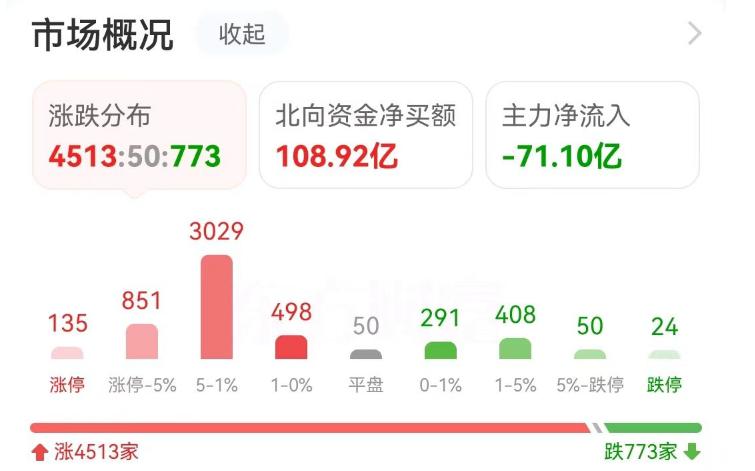
Real estate stocks are on the rise.
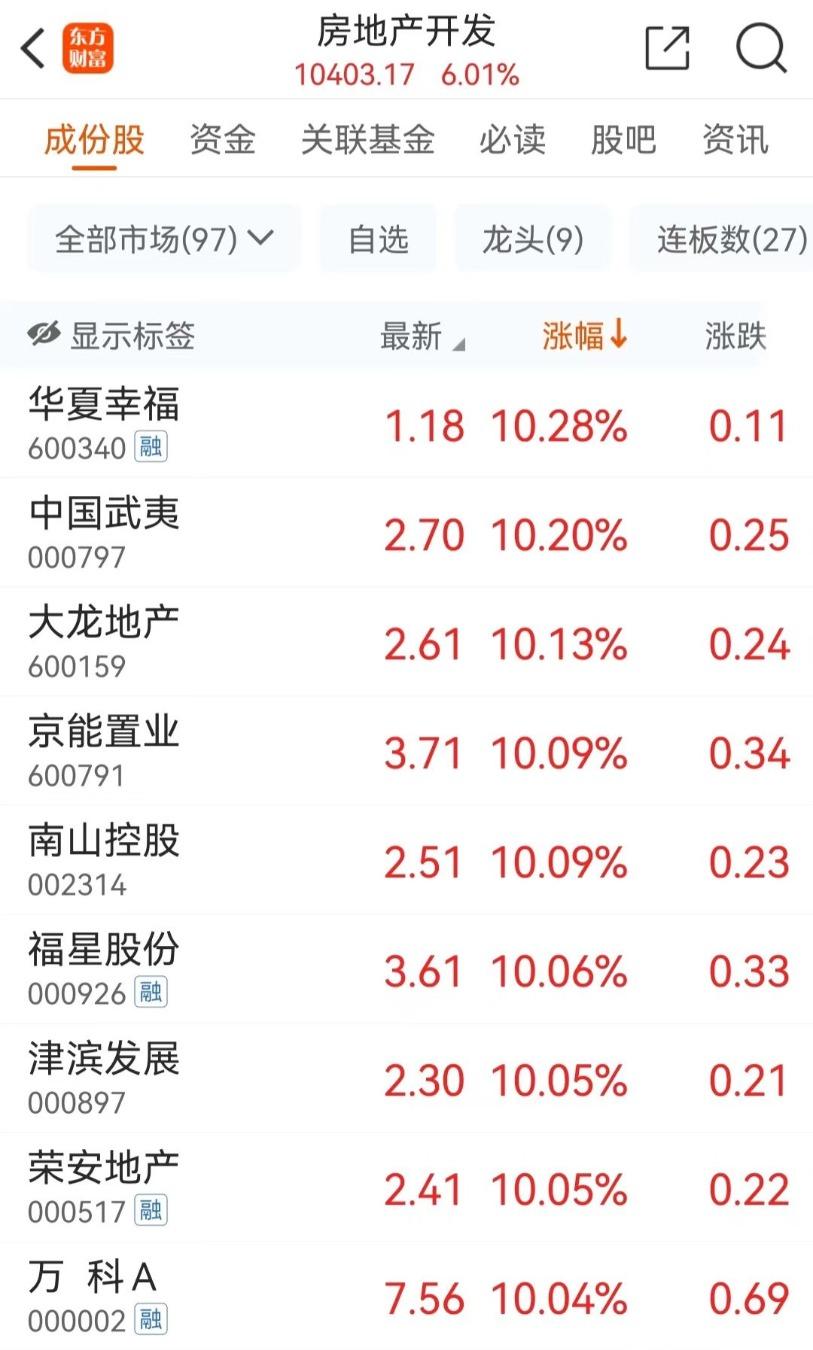
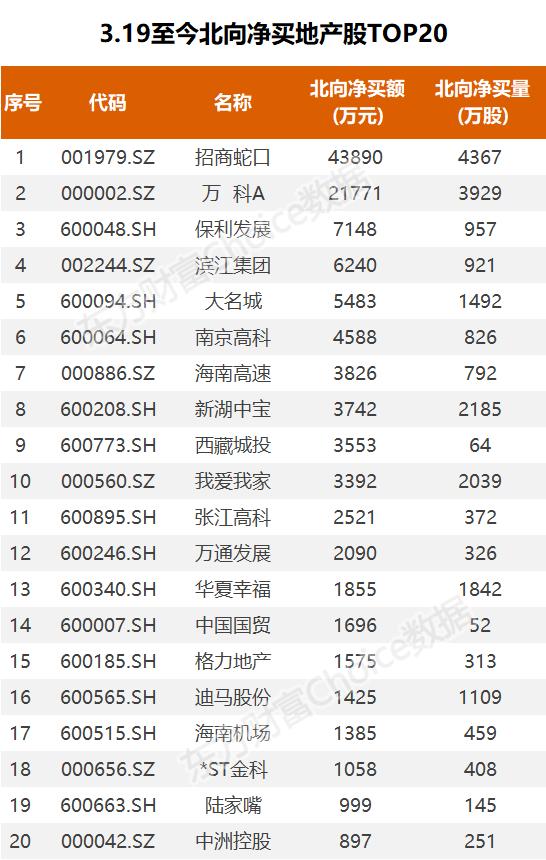
Northbound funds: grab 34 real estate stocks against the trend.
Institutional outlook
According to Cailian, from the policy point of view, since April, favorable support policies for local property markets have been introduced one after another, and the loosening of "purchase restriction" has become the main trend. Following the hot provincial capital cities such as Wuhan, Hefei, Nanjing and Changsha, Chengdu also announced the complete cancellation of the purchase restriction. According to the monitoring of the Central Finger Research Institute, up to now, except Hainan Province, among the core cities, four first-tier cities such as Beijing, Shanghai, Guangzhou and Shenzhen, and core areas such as Hangzhou (new house), Tianjin and Xi ‘an still maintain the purchase restriction policy.
According to the forecast of China Central Index Research Institute, from the policy point of view, the central and regulatory authorities have made it clear that real estate policies should be further optimized, and there are strong optimization expectations for both supply and demand policies in various places. It is expected that first-tier cities will continue to optimize the purchase restriction policies, and second-tier cities are expected to completely cancel the restrictive policies.
Zhang Dawei, chief analyst of Zhongyuan Real Estate, said that from a policy perspective, the era of comprehensive unlimited purchase has arrived. In the past three years, many cities have lifted restrictions on purchases, such as Dongguan and Foshan. Among the first-tier cities, Guangzhou has greatly relaxed the purchase restriction, and Shenzhen has lifted the purchase restriction in the Shenzhen-Shantou Cooperation Zone. Beijing and Shanghai have also loosened, and the loosening of purchase restrictions has become a trend. With the deepening of urbanization and the improvement of people’s living standards, the demand for improvement will become a demand for continuous growth. China’s policies have a great impact, which has been reflected by the strong performance of real estate stocks. The market generally expects that there may be a heavy policy during the May Day period, and the strength of the policy will determine the speed of market stabilization.
Foreign-funded institutions are also beginning to be optimistic about the real estate market in China. John Lam, head of real estate research at UBS in Greater China, said that with the help of the government, UBS became more optimistic about the real estate industry in China for the first time. Lu Ting, chief economist of Nomura China, recently reminded the market not to be blindly optimistic, thinking that the real estate market may still be in an L-shaped downward phase. However, he also pointed out that the real estate market may usher in a clearing opportunity this year, and with the solution of the problem, the market is expected to bottom out and rebound.
(Article source:eastmoney terminalResearch center)

关于作者