On April 14th, 1912, the RMS Titanic, a so-called "unsinkable" ship, hit an iceberg on its first voyage-from Southampton, England to new york, USA. Only 2 hours and 40 minutes later, the cruise ship sank.
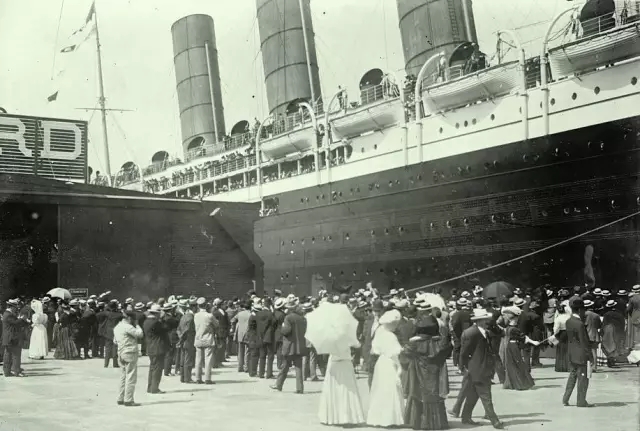
In the end, more than 1,500 of the 2,224 crew members and passengers were killed, making it the most widely known shipwreck so far. After that, there are stories about the love between Jack and Ruth, and the gentleman’s behavior of "women and children first" protocol, but this may not be the case … Over the past hundred years, most of the more than 700 survivors have been recorded in history. However, you may not know that among the more than 700 survivors, there are 6 Chinese. And their stories are little known.
Recently, Arthur Jones, a British director, filmed a documentary called The Six, and interviewed their descendants to restore the bitter story of that year.
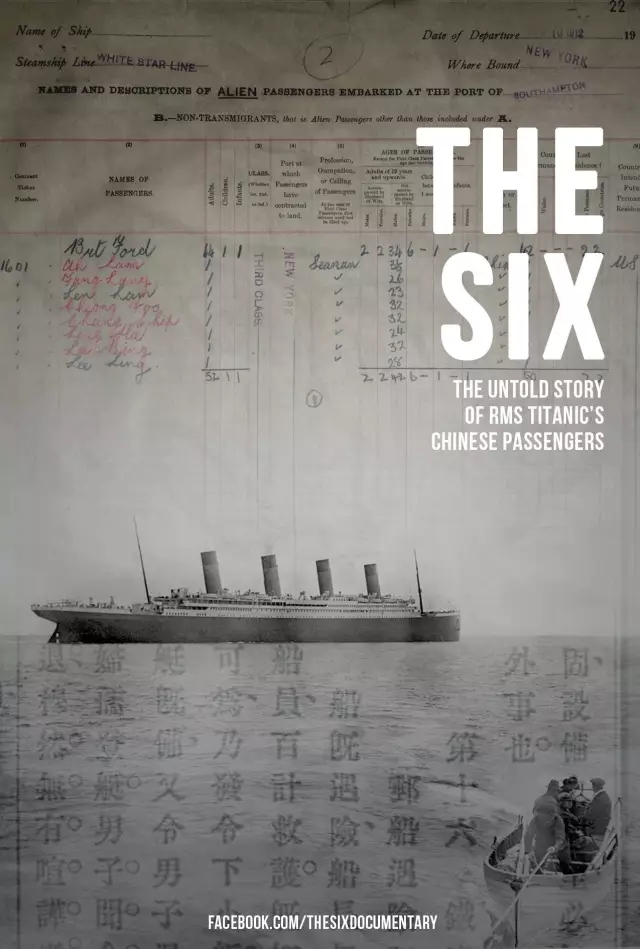
Who are these six people?
At that time, eight Chinese boarded the Titanic, and six of them survived. Their registered names are: Fang Lang, Lee Bing, Ali Lam, Chang Chip, Choong Foo, Lee Ling, Ling Lee and Len Lam. There are three Chinese names available: Zhong Jie, Li Bing and Bing Xin. The youngest is 24 years old and the oldest is 37 years old. They are all boiler-burning workers on board, and they are the lowest jobs on the Titanic, working 14 or 15 hours a day.
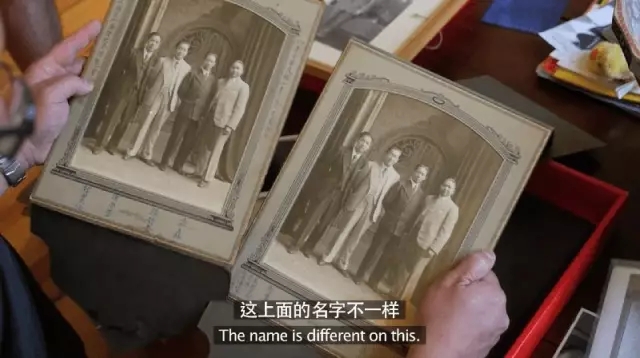
In order to save costs, shipping companies liked to recruit Chinese crew members at that time. They only had one ticket. The fare was 59 pounds, 9 shillings and 11 pence, which could be used by 8 people. Third class, number 1601. In other words, they live with "Jack". The salary is only one-fifth of that of a white crew member with the same job.
How were they rescued?
At that time, after the ship had an accident, the crew first informed the rich in the first class. People in the third class didn’t know that the ship was going to sink, and even if they did, they couldn’t escape because the hatch was locked. Later, the hatch was opened and people in the third class flocked out. But many lifeboats have been lowered.

It is reported that five of them in Chinese found a broken boat on the deck. Together, the five men, Qi Xin, threw the boat that could not actually save lives into the sea, then jumped into the sea and was immersed in the water. Fortunately, I met a lifeboat and was rescued. Another Chinese Fang Lang, according to Sixth Tone, was lucky to be rescued by lifeboat No.14, which was also the only ship that returned to the cruise ship to search for survivors.
But at that time, the people on the lifeboat argued about whether to save the Asian.
Twenty-six-year-old sailor Fang Lang was lashed to a floating piece of the Titanic when one of its few lifeboats spotted him.
Fang Lang, a 26-year-old crew member, was seen on the lifeboat at that time. He was tied to a piece of wreckage of the Titanic.
Before he lost consciousness Fang had tied himself to the frail raft, using the broken hinges to make the knots secure. It wasn’t clear whether he was alive or dead. In any case, an officer on the lifeboat reasoned, “there’s others better worth saving than a Jap.”
Fang Lang tied himself to the goal board before losing consciousness, and used some broken hinges to ensure that the knot didn’t come loose. At that time, it was impossible to tell whether he was dead or alive. The officer on the lifeboat (who thought he was Japanese) said, "It is better to save everyone than a Japanese."
Others on board disagreed. They pulled forward, plucked him from the sea and warmed him up.
But other people on board disagreed with from ruin. They rowed the boat to Fang Lang, rescued him from the sea and warmed him up.
Unexpectedly, Fang Lang’s behavior after waking up won the respect of all passengers.
In the oral record of a second-class survivor, Charlotte Collyer, he mentioned Fang Lang like this:
In less time than it takes to tell, he opened his eyes. He spoke to us in his own tongue; then, seeing that we did not understand, he struggled to his feet, stretched his arms above his head, stamped his feet, and in five minutes or so had almost recovered his strength.
He soon opened his eyes and spoke to us in his language, but found that we couldn’t understand him, so he stood up, stretched his arm and stamped his foot. After about five minutes, he recovered his strength.
One of the sailors near to him was so tired that he could hardly pull his oar. The Japanese bustled over, pushed him from his seat, took the oar and worked like a hero until we were finally picked up.
A sailor beside him was so tired that he could hardly paddle. The Japanese (rescued Chinese Fang Lang) took the initiative to push the sailor away, picked up the paddle and rowed like a hero until we were rescued by the big ship.
"I’m ashamed of what I said about the little blighter. I’d save the likes o’ him six times over, if I got the chance", said the officer.
The officer later said, "I’m ashamed to speak ill of this guy like that. If I had the chance, I would save someone like him six times."
After surviving, what comes is gossip and discrimination.
Although we know little about them today, at that time, their survival attracted a lot of attention in the western world, but these concerns were by no means well-intentioned.
In a report on April 19th, 1912, Brooklyn Daily Eagle said:
“No one could tell where the Chinese came from, not how they got in the boats, but there they were.”
"No one can tell where these Chinese came from, and I don’t know how they got on the lifeboat, but they sat in it well."
While the official investigation on the sinking of the Titanic was going on, the owner of the Titanic, J. Bruce Ismay, said:
The Chinese men were found stowed away under the seats after the lifeboat cleared the Titanic.
These Chinese were found hiding under the seat after the lifeboat had left the Titanic.
Ironically, Ismay himself, who made this remark, was later reported by the media as the one who wanted to advance his own lifeboat regardless of the principle of "ladies and children first", and thus became the laughing stock of people.
J. Bruce Ismay was pilloried not only for the liner’s lack of lifeboats but also for boarding one of those boats himself.
J. Bruce Ismay became a laughing stock, not only because there were not enough lifeboats, but also because he himself boarded one of them.
Arthur Jones, the director of this documentary, suspected that Ismay said that Chinese was hiding under the seats, and it might just be that these Chinese were squatting down between the seats.
“That would make complete sense if you know anything about China or Chinese laborers,” he said, as it is common to see Chinese workers resting in a squatting position.
He said: "If you know the workers in China or China, you will know that this is entirely possible," because China workers like to squat and rest.
In addition, there are many rumors about Chinese: some people say that they "let down their braids and pretended to be women" in order to board the boat, or they "jumped into the lifeboat from the deck and trampled the female passengers in the boat" and so on.
Jones said in an interview: We all think this rumor is false, and there is no clear evidence to confirm this speculation. Only some unreliable people have provided vague testimony. Some evidence shows that the four China people boarded the lifeboat only after the women and children had boarded the lifeboat. Not only Chinese, but also many "foreigners" were harmed by such insulting rumors. We think this insulting statement is due to racial discrimination at that time.
Maritime historian Steven Schwankert also thinks:
Their story is “one of courage and of quick thinking,” not cowardice.
Their stories actually show "courage and wit", not cowardice.
It is worth noting that the United States in 1912 was still in the anti-China sentiment created by the Chinese Exclusion Act in 1882.
When all the survivors came to new york, they felt great help and warmth from the local area.
However, the six China survivors failed to enter the United States, but were deported within 24 hours after arriving at Ellis Island.
They were brought to Ellis Island, but sent away the following morning due to the Chinese Exclusion Act.
According to the Chinese Exclusion Act, they were taken to Ellis Island and sent away early the next morning.

Survivors in China are subjected to extremely strict screening and cannot land in the United States.
They turned around on the "Annetta" and returned to the Atlantic Ocean, heading south for Cuba. From then on, I don’t know where to go, I don’t know how to live or die, and I have disappeared from history.
They know nothing about what is happening in the United States, so there is no excuse. These six Chinese, under the consistent rendering of the media, became the proof that Chinese was unruly, cunning and treacherous, and became a well-known villain in the West.
Until today, I haven’t been able to wait for an apology.
Looking for their stories
It’s been 105 years now. What are the stories of the six China survivors? British director Arthur Jones and his team are shooting the story of these survivors and their descendants-"The Six". In order to find more clues about the six survivors, the film crew also went online on August 25 to find clues, hoping that more people could provide information.
Arthur Jones, the director, said that some of the six survivors came from southern China. I hope local people, especially friends in Guangdong Province, can contact us and provide anything they know, even rumors about their families.

In an interview, the director said: I like this story because most people think they know the Titanic. The impression about the Titanic is just a sunken ship, with many European and American whites on board, the poor and the rich … I think the story of China survivors is also a part of history, which belongs to China and the world. China has developed a strong interest in this story. I think it is necessary to emphasize that the story of the Titanic is also related to China.
(Source: China Daily Bilingual News Editorial Department)

关于作者