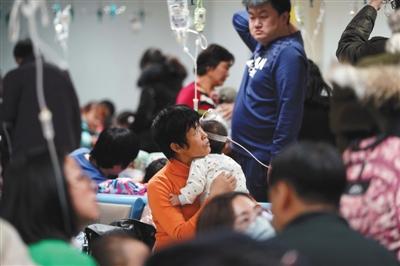
On January 10, a parent accompanied the child with infusion at Beijing Children’s Hospital. According to the latest influenza surveillance released by Beijing CDC, it is expected that the intensity of influenza activity in Beijing will slow down in the next two weeks. Xinhua news agency
According to the Municipal Health Planning Commission, at present, there is no obvious variation in influenza viruses; Flu activity will slow down in the next two weeks.
The Beijing News (Reporter Dai Xuan) Recently, the flu epidemic in Beijing reached its peak, and a large number of patients flocked to the hospital for treatment. The Beijing Municipal Health Planning Commission announced yesterday that the epidemic situation of influenza concentrated fever reported in Beijing has dropped sharply, with the first week of 2018 falling by 74% compared with the last week of 2017. There is no obvious variation in all types of influenza viruses, and there is no biological basis for influenza pandemic.
In the first week of 2018, the epidemic situation decreased by 74% from the previous month.
Recently, the high incidence of influenza in Beijing has aroused social concern.
Yesterday, the Beijing Municipal Health Planning Commission released the latest data on influenza surveillance. The results of influenza surveillance in the Municipal Center for Disease Control and Prevention show that since November 2017, the intensity of influenza activity in Beijing has shown an upward trend, especially since December.
However, the increase in the intensity of influenza activity in Beijing has shown a slowdown. The epidemic situation of concentrated influenza fever reported in Beijing has dropped sharply, with the last week of 2017 dropping by 37% compared with the previous week, and the first week of 2018 dropping by 74% compared with the last week of 2017.
According to the analysis of influenza surveillance data in Beijing over the years, the peak of influenza activity in Beijing this epidemic season appears around New Year’s Day, and the incidence is at a high level in recent years. At present, it has reached the peak of influenza epidemic, and it is expected that the intensity of influenza activity in Beijing will slow down in the next two weeks. The number of reported cases of influenza concentrated fever in schools and kindergartens has dropped significantly compared with the previous period. It is expected that the intensity of influenza activity in Beijing will be further reduced with the coming of winter vacation and Spring Festival holiday in schools and kindergartens.
The population aged 0-4 accounted for the highest proportion of cases.
At present, the activity of influenza virus in Beijing is still at a high level, and influenza viruses of type B (Yamagata strain), type A H1N1 and type A H3N2 are co-prevalent. Recently, the proportion of influenza B (Yamagata strain) virus and influenza A (H1N1) virus is relatively high. At present, among all age groups of influenza-like cases, the 0-4 age group accounts for the highest proportion.
Gao Xiaojun, spokesman of the Beijing Municipal Health Planning Commission, said that according to the global, China and Beijing influenza surveillance data, there is no obvious variation in all types of influenza viruses at present, and there is no biological basis for influenza pandemic. The infectivity, transmission and pathogenicity of influenza viruses have not changed. The clinical manifestations of influenza patients in this epidemic season still meet the basic characteristics of typical seasonal and periodic influenza.
In the next step, Beijing will continue to carry out influenza surveillance and epidemic research, grasp the activity level and epidemic dynamics of influenza virus, and release early warning information in time. In view of the high epidemic rate of young students in primary schools and kindergartens, the education, health and family planning departments at the two levels in urban areas cooperate with each other to strengthen relevant inspections, and students infected with influenza will be guided to medical institutions for treatment.
Dispel doubts 1
Is the supply of anti-influenza drugs sufficient at present?
Hospital supply is no problem, oseltamivir has increased production capacity, and citizens do not need to hoard drugs.
Recently, many citizens have reported that there is a shortage of anti-influenza drugs such as oseltamivir. What is the current inventory of medical institutions?
Liu Lihong, chief pharmacist of Beijing Hospital Authority, said that according to the epidemic monitoring in Chaoyang Hospital, this year’s flu was half a month earlier than expected, which led to insufficient preparation of various production enterprises. In addition, oseltamivir is mainly used in medical institutions, and the production enterprises mainly ensure the use of drugs in hospitals. Some private pharmacies may be in short supply, and now they have increased their production capacity. Oseltamivir is the core drug for treating influenza. Besides imported Tamiflu, there are also domestic oseltamivir capsules and granules for children. At present, the market in Beijing is stable and sufficient. "The number of outpatients in the respiratory department of Chaoyang Hospital is so large that we are worried that the drugs are out of stock, but there is no such thing, so there is no problem with the supply, and the public does not need to hoard drugs."
She also reminded that oseltamivir is a prescription drug and needs professional medical personnel to provide different treatment schemes according to the characteristics of different populations and the degree of mild to moderate severity. For example, the recommended dose for children under the age of 13 is calculated according to kilogram weight, and 75mg is recommended twice a day for young adults. The elderly, especially patients with renal insufficiency, need to adjust the dose. Therefore, citizens should not buy at pharmacies at will, but must use drugs reasonably under the guidance of doctors.
Disambiguation 2
Why don’t some community hospitals accept patients with fever?
Only the common cold and flu are accepted at the grassroots level; The elderly belong to five high-risk groups of influenza, so community treatment is risky.
Fever is a common symptom after influenza infection. However, some citizens reported that they wanted to see the disease at home, but the community hospital said that they could not see it and had to go to a big hospital. In this regard, the relevant person in charge of the Medical Administration Department of the Beijing Municipal Health Planning Commission introduced that it is not impossible for the grassroots to receive fever patients, but only a part of them.
She introduced that ordinary colds and flu have the ability to receive treatment at the grassroots level, but leukemia, malignant lymphoma, systemic lupus erythematosus, etc. may cause fever, and the grassroots cannot receive treatment. "There are many cases that cause fever, and the flu is not the only reason. Bacteria, viruses and mycoplasma can cause fever. " In addition, most of the elderly people in the community see a doctor, and the elderly people belong to five high-risk groups of influenza, so there are risks in community treatment. In addition, some small community health service stations have limited space and have not reserved influenza antiviral drugs. Based on the comprehensive judgment, the community may suggest some people to seek medical treatment elsewhere.
"In fact, it can be found on the Beijing Pharmaceutical Sunshine Purchasing Platform that many community health service centers have purchased antiviral drugs such as oseltamivir, which is for such patients." She suggested that the public can learn about the drug reserves and receiving capacity of the nearby community through online or telephone consultation, and then go to see a doctor.
Disambiguation 3
What should we pay attention to in preventing and treating influenza?
Vaccination is the most effective preventive measure; If there is no diarrhea and dehydration, the general flu does not need infusion.
Li Xingwang, chief physician of beijing ditan hospital Infectious Diseases Clinic, said that influenza is a seasonal infectious disease, and vaccination is the most effective preventive measure. In addition, because influenza virus can be spread by droplets, it is recommended to go to public places with dense crowds as little as possible during the epidemic season. You can wear a mask when you go to the hospital or visit patients.
Besides, Ying Qin washes his hands and ventilates frequently in his daily life. Although some people carry the virus, they have not yet attacked. Therefore, when sneezing and coughing, you should cover your mouth and nose with handkerchiefs and toilet paper to prevent it from spreading to others.
He also stressed that for high-risk groups such as the elderly over 65, basic diseases, infants, and pregnant women in the middle and late stages, in addition to the above measures, anti-influenza drugs can also be taken for prevention. When a family member is infected with influenza virus, try to isolate from others, and you can also take anti-influenza drugs to avoid infection or alleviate flu symptoms. In addition, unless there are special circumstances such as diarrhea and dehydration, infusion is generally not needed to treat influenza.
Some citizens wonder why it is the same flu, and doctors give different treatment plans to different people. Li Xingwang explained that common cough and fever can be treated as symptoms. For severe and high-risk groups, doctors may recommend antiviral treatment. The public should follow the doctor’s advice for the specific treatment plan.
■ initiatives
Prolonging the time of outpatient service and relieving the pressure of medical treatment
In order to cope with the flu peak, many large hospitals in Beijing have introduced convenience measures to alleviate the pressure of seeing a doctor by extending the time of pediatric outpatient and emergency departments and increasing the number of doctors.
Recently, the number of outpatient and emergency visits in the Capital Institute of Pediatrics is about 6,200. According to the fluctuation of outpatient and emergency visits, the hospital has increased the number of outpatient and emergency visits, and also launched the "Love Clinic" activity, which provides two-hour centralized outpatient service from 17: 00 to 19: 00 every day to support the clinical frontline.
Since the flu season, the peak number of pediatric outpatient visits in Beijing Friendship Hospital has reached 1,100, a year-on-year increase of 138.5%. The hospital has extended the time for prescribing drugs, and the pediatric clinic has also improved the consultation process according to the needs. In advance, the triage nurse will prescribe blood and stool routine laboratory sheets as appropriate, increase the number of personnel and equipment in the inspection department, reduce the number of children returning, increase the work efficiency of doctors and reduce the waiting time.
The pediatric department of Beijing Hospital of Traditional Chinese Medicine started the emergency plan. Doctors stopped taking vacations and made additional visits on weekends to strengthen the outpatient service to meet patients’ medical needs.
According to the Beijing Municipal Health and Family Planning Commission, at present, 147 secondary and above medical institutions in Beijing provide pediatric diagnosis and treatment services, which can receive 20,000 children every day, basically meeting the current needs.

关于作者